
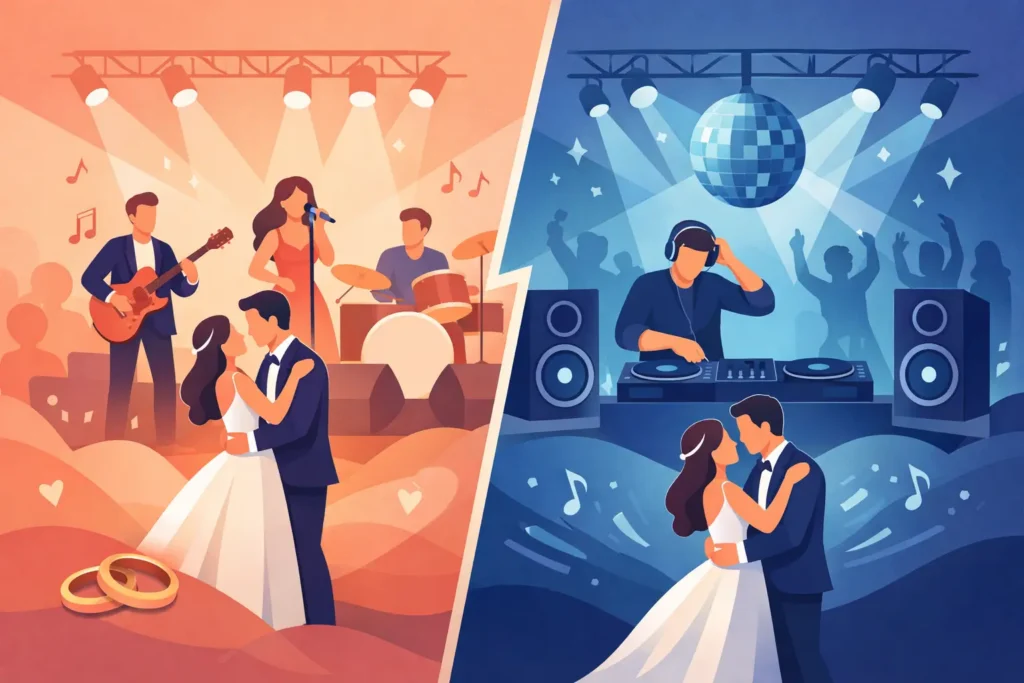
The moment your reception starts, your entertainment choice stops being a line item and becomes the atmosphere. That is why the band versus DJ wedding decision matters more than many couples expect. Music shapes the pace of the night, fills quiet moments, signals transitions, and helps guests feel like they are part of something memorable rather than simply attending another event.
For some couples, the answer is obvious. They have always pictured a live band keeping the dance floor full. Others want a skilled DJ who can move from dinner music to packed-floor favorites without missing a beat. Most couples, though, land somewhere in the middle. They want great energy, strong value, smooth logistics, and a guest experience that feels polished from the first song to the final sendoff.
Band versus DJ wedding entertainment: the real difference
A live band brings presence. There is a visual impact that starts before the first note. Guests see performers, instruments, microphones, and movement on stage, and that naturally creates excitement. A strong band can make big moments feel even bigger, especially introductions, first dances, and open dancing later in the evening.
A DJ brings flexibility. Instead of performing a set version of a song, a DJ can play the original track your guests already know and love. That matters if your must-play list ranges from classic Motown to 2000s hip-hop to current pop to Tejano favorites. A talented DJ can also read the room in real time and shift genres quickly when the crowd changes.
Neither option is automatically better. The right choice depends on your priorities, your budget, your venue, and the kind of experience you want your guests to remember.
When a live band is the better fit
If your wedding vision leans elevated, energetic, and performance-driven, a band may be the stronger match. Live music has a way of making the reception feel like an event inside the event. It adds texture and personality, and it often feels especially strong in larger ballrooms, outdoor tented receptions, and high-energy celebrations where entertainment is a central feature.
Bands also work beautifully for couples who want a sense of occasion. The live vocals during your first dance or parent dances can feel personal and dramatic in the best way. For black-tie weddings, luxury celebrations, or receptions where guests love to dance, a great band can become one of the most talked-about parts of the night.
That said, bands are not only about style. They also require more planning. A band typically needs more space, more setup time, and more technical coordination. There may be breaks between sets unless the group provides recorded music during those moments. Song selection can also be more limited than with a DJ, especially if you want very specific original recordings.
For couples planning in Texas, venue logistics matter here. Historic venues, ranch properties, hotels, and outdoor spaces all have different sound rules, loading access, and power requirements. A band can absolutely work in these settings, but it benefits from careful coordination.
What to think about before booking a band
Ask how many musicians are included, whether they provide an emcee, how they handle breaks, and what songs are already in their repertoire. You should also ask about stage size, power needs, ceremony music options, and whether they can learn special songs for key moments.
The more detailed the planning conversation, the smoother the entertainment experience will feel on the wedding day.
When a DJ is the better fit
A DJ is often the smartest choice for couples who want range, efficiency, and strong value. DJs can cover a wide variety of musical styles in one night without requiring a large physical setup. That makes them especially useful for weddings with diverse guest lists, mixed age groups, or couples who want several genres represented throughout the evening.
A DJ can also support the full event flow in a very practical way. Ceremony music, cocktail hour, dinner sound, introductions, toasts, dance sets, and closing songs can all be handled through one entertainment partner. That simplicity can reduce coordination issues and save both time and money.
If your reception priorities include hearing the original versions of favorite songs, minimizing space requirements, or staying within a tighter budget, a DJ often wins the band versus DJ wedding debate. A strong DJ can still create high energy. The difference is that the experience feels more curated and track-driven rather than performance-led.
The caution is that DJ quality varies widely. A great DJ does far more than press play. They manage pacing, read guest response, make clean announcements, balance volume, and know when to shift the mood. A weak DJ can make a beautiful reception feel disjointed, so vetting matters.
What to ask before booking a DJ
Find out how they build playlists, how much input you will have, and whether they act as the emcee. Ask how they handle do-not-play lists, multicultural music requests, ceremony sound, and backup equipment. You also want clarity on setup times, overtime rates, and whether lighting is included.
Those details may sound small at first, but they affect how polished the full reception feels.
Budget changes the conversation
For many couples, budget is where the decision becomes clearer. In most markets, a live band costs more than a DJ. The difference can be significant depending on band size, travel, production needs, and event length.
That does not mean a band is an unnecessary luxury or that a DJ is a compromise. It simply means each option delivers value in different ways. A band delivers live impact and performance energy. A DJ delivers variety, flexibility, and efficiency.
If entertainment is one of your top three priorities, it may make sense to invest more heavily there. If you are balancing floral design, catering, photography, rentals, and guest count, a DJ may free up room in the budget without sacrificing a great guest experience.
This is where thoughtful planning really helps. At Adam’s Event Planning, we often remind clients that the best entertainment choice is not the most expensive one. It is the one that fits the overall event design, the venue, and the guest experience you want to create.
Guest experience should guide the decision
Think about your crowd, not just your personal playlist. Are your guests eager dancers who will stay on the floor all night? Do you have a broad age range that needs musical variety? Is this an intimate wedding where subtle ambiance matters more than all-out party energy? Those answers matter.
A live band can be a standout choice for guests who love the excitement of a performance. A DJ can be ideal when you need wide musical coverage and smooth transitions across generations and tastes. If your family celebration includes cultural traditions or genre-specific favorites, confirm that your entertainment partner can handle those moments confidently.
Reception timing matters too. A shorter, high-energy reception may benefit from a band’s momentum. A longer evening with multiple transitions may favor a DJ’s flexibility.
Venue and logistics matter more than couples realize
Entertainment does not exist in a vacuum. Your venue may have sound limits, loading restrictions, indoor-outdoor transitions, or limited staging space. A ballroom can usually handle a larger band more easily than a compact restaurant venue. An outdoor wedding may require extra sound planning, weather backup, and power support.
A DJ often offers simpler logistics, but that does not mean no planning is needed. Sound quality, speaker placement, microphone coverage, and timeline coordination are still essential. The goal is not just to have music playing. The goal is to have music support every moment cleanly and professionally.
Is a hybrid option worth considering?
Sometimes the best answer is not strictly one or the other. A couple might choose a DJ for the reception and bring in a live musician for the ceremony or cocktail hour. Others may book a smaller band and have a DJ take over after the live set ends.
This can be an excellent middle ground if you want some live music without committing your full entertainment budget to a large band. It can also help when you want a more layered guest experience without overcomplicating the event.
The key is making sure the handoff between entertainment elements is coordinated well, with clear timing, equipment planning, and volume management.
How to make the final call
If you are stuck, ask yourself a simpler question. What do you want guests to say on the drive home? If the answer is, “That band was incredible,” you probably know where you are leaning. If the answer is, “We danced to everything and never wanted to leave the floor,” a DJ may be the stronger fit.
There is no universal winner in the band versus DJ wedding decision. There is only the right fit for your celebration, your space, and your priorities. When entertainment is chosen with intention, it does more than fill the room with sound. It gives your wedding rhythm, personality, and the kind of energy people remember long after the last song ends.